Portuguese exodus from Angola
Another Day of LifeThe Portuguese exodus from Angola was both a mass departure and a dismantling of everyday life in Luanda. As residents fled an approaching war, the airport became a makeshift settlement, flights carried people away, and crates containing the contents of homes formed a wooden city that was later shipped across the Atlantic. The stone city remained behind, progressively emptied of residents and essential services, while the people who left scattered across Europe, America, and South Africa.
Causes and Scale
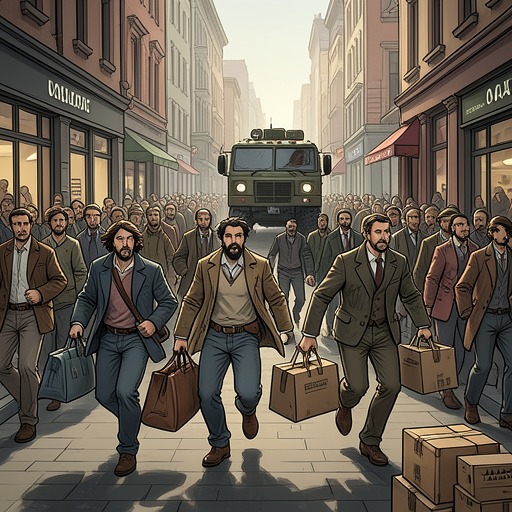
By the end of September, Luanda appeared briefly more active as people hurried to settle affairs and leave before the fighting reached the city. Portuguese residents arrived from distant parts of Angola in cars loaded with passengers and baggage. Refugees joined into larger travelling groups, seeking greater safety on the way to the capital. They first filled the hotels; when rooms ran out, they went directly to the airport. The anticipated airlift was immense: half a million refugees were to be transported to the other side of the world.
Fear of the coming months helped drive the rush. Residents predicted that September could be survived, that October would be worse, and that few would survive November. These expectations were presented as the accumulated knowledge of people who had lived in the country for years, but they were forecasts, not certainties. Some blamed the political upheaval and the fighting among Angolans for their predicament. Others voiced racist assumptions about black Angolans and doubted their ability to govern. The departure was therefore shaped not only by immediate danger but also by the Portuguese residents’ fear, resentment, and sense that their lives and claims to the country were coming to an end.
They described leaving as an escape with their lives and possessions, often believing they would never return. Some feared losing the savings and work of decades; one resident’s account of forty years in Angola ended with an old taxi left in the street. The scale of the expected airlift and the uncertainty about when or where people would fly turned private decisions to leave into a collective crisis.
The Airport and the Struggle to Leave
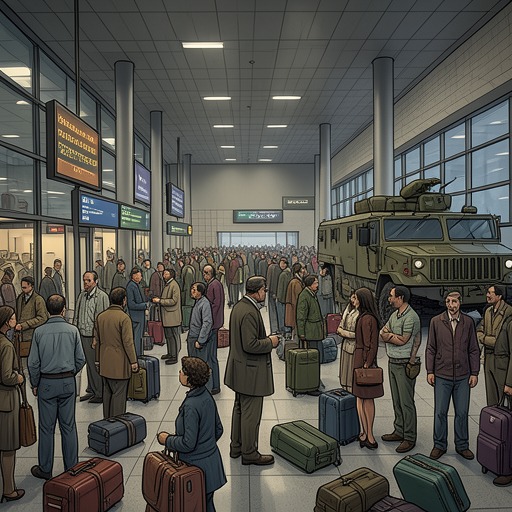
The airport became a roofless settlement. People lived outside in the rain, often in conditions worse than those of residents in the adjoining African quarter. Families waited for weeks without knowing when a flight would take them or where it would go. Despair periodically became open protest: women confronted soldiers assigned to maintain order, and men tried to seize a plane to make their situation known beyond Angola.
No proposed rule for assigning seats satisfied the crowd. Priority was discussed for pregnant women, mothers with infants, and women with older children, while others argued that their own circumstances should count. When some of the strongest passengers tried to board, women with children blocked the aircraft from taxiing by lying on the tarmac. The army intervened, removed the men, and ordered the women to board. The episode made departure a matter of contested access, not simply a queue: a place on a flight could mean leaving the country, while those still waiting had no clear assurance of when they would go.
In the first days of October, several planes a day arrived from France, Portugal, Russia, and Italy. Their pilots seemed to come from a distant world, while the overloaded aircraft struggled to lift from the runway before disappearing into the night. The nomad settlement around the airport gradually vanished as the refugees departed. The air bridge was the visible human route out; another, slower route carried the substance of their former homes.
The Wooden City
Residents packed their belongings into crates, and the price of boards, plywood, hammers, and nails rose. Building a crate became a practical necessity and a subject of expertise and status. Wealthier residents could construct larger, more elaborate containers; some were lined and fitted to carry the contents of entire rooms. Furniture, household goods, clothing, kitchen supplies, decorations, and family photographs went into the boxes. The aim was to leave as little as possible behind, even as the shrinking crate forced choices about what could fit.
At night, people transferred the contents of their houses into the crates. As this continued, the crate replaced the house in their daily attention: residents spoke of checking their crate rather than going home. Luanda’s stone buildings became, in the account of the departure, an empty setting for a life already packed away. The crates accumulated into a second, temporary city inside the first.
The wooden city was moved by truck to the port and eventually carried out to sea. Its residents had already dispersed, but their household belongings travelled in sections toward Lisbon, Rio de Janeiro, and Cape Town. Maria later wrote that her crates had reached Brazil; reports described another section reaching Cape Town; and Rysiek saw large heaps of crates near the port in Lisbon. The city that had been assembled for departure thus became cargo, divided among distant destinations rather than restored as a community in one place.
The City Left Behind
The exodus left more than empty homes. As Luanda grew more depopulated, shops closed and restaurants and cafés ceased operating. Police had left the city, and the fire service and refuse collectors were also gone. The empty fire station still held its engines and equipment, but there was no crew. Soldiers later tried to use a fire engine to carry water to the front; it was struck and abandoned. Garbage accumulated in streets and squares, while the last residents had fewer ways to manage the resulting public-health dangers.
Water was also increasingly precarious, though its immediate cause was the fighting around the supply system. The pumping stations lay on the front lines and were repeatedly destroyed after repairs. In one hotel, a tap yielded nothing; the last wells were running dry, and a worker said the city could not continue without water. In the early days of October, the remaining residents faced shortages alongside the departure of medical services and the erosion of municipal order. These failures did not constitute a single moment of collapse. They accumulated as people left, infrastructure came under attack, and fewer workers remained to keep the city functioning.
The contrast between the departing wooden city and the abandoned stone one gives the exodus its central image. Portuguese residents carried their possessions away in a convoy of crates, while cars, buildings, roads, and benches remained in Luanda. A soldier watching the crates leave treated their departure as a loss, but also as evidence that Angola was now his home. The episode does not turn that contrast into a simple reconciliation: it holds together the material reality of a mass flight, the fear and uncertainty that propelled it, and the different claims to belonging left in its wake.